Daily Cryptogram
A new puzzle every day!
Decode the hidden quote by substituting letters. Each letter in the cryptogram represents a different letter of the alphabet.
Prefer pencil and paper? Printable version now available!
Yesterday's Answer: "We must accept finite disappointment but never lose infinite hope in the face of any challenge we may encounter" — Martin Luther King Jr.
How to Play
- Select a letter in the puzzle to highlight it
- Use the keyboard to guess the original letter
- Correct guesses fill in all matching letters automatically
- Wrong guesses show a strikethrough - try again!
- Use hints if you get stuck (3 per puzzle)
This Day in History
- 1787politics
U.S. Constitution Signed
- 1826birth
Bernhard Riemann Born
- 1939war
Soviets Invade Poland
- 1978politics
Camp David Accords
- 2011politics
Occupy Wall Street Begins
Phrase Origin
"Red tape"
Official documents in England and other European countries were traditionally bound with red ribbon or tape. The phrase came to symbolize excessive bureaucracy by the 16th century, as dealing with governmental paperwork literally required untying yards of red tape. Charles Dickens frequently used the term to criticize government inefficiency.
Never Miss a Puzzle
Get a daily email reminder when the new puzzle is ready.
This site is protected by reCAPTCHA and the Google Privacy Policy and Terms of Service apply.
A Brief History of Cryptograms
A brief history of cryptograms. Cryptic code writing can be traced back to Sparta in about 600 BC, used to send military strategy and secrets. It was commonly used for military purposes throughout the years and still until this day. Then around 900 AD monks started using them for entertainment purposes. Edgar Allan Poe was fascinated with them and challenged readers to send him ciphers. The specific English term "cryptogram" was coined around 1849 from Greek roots meaning "hidden word."
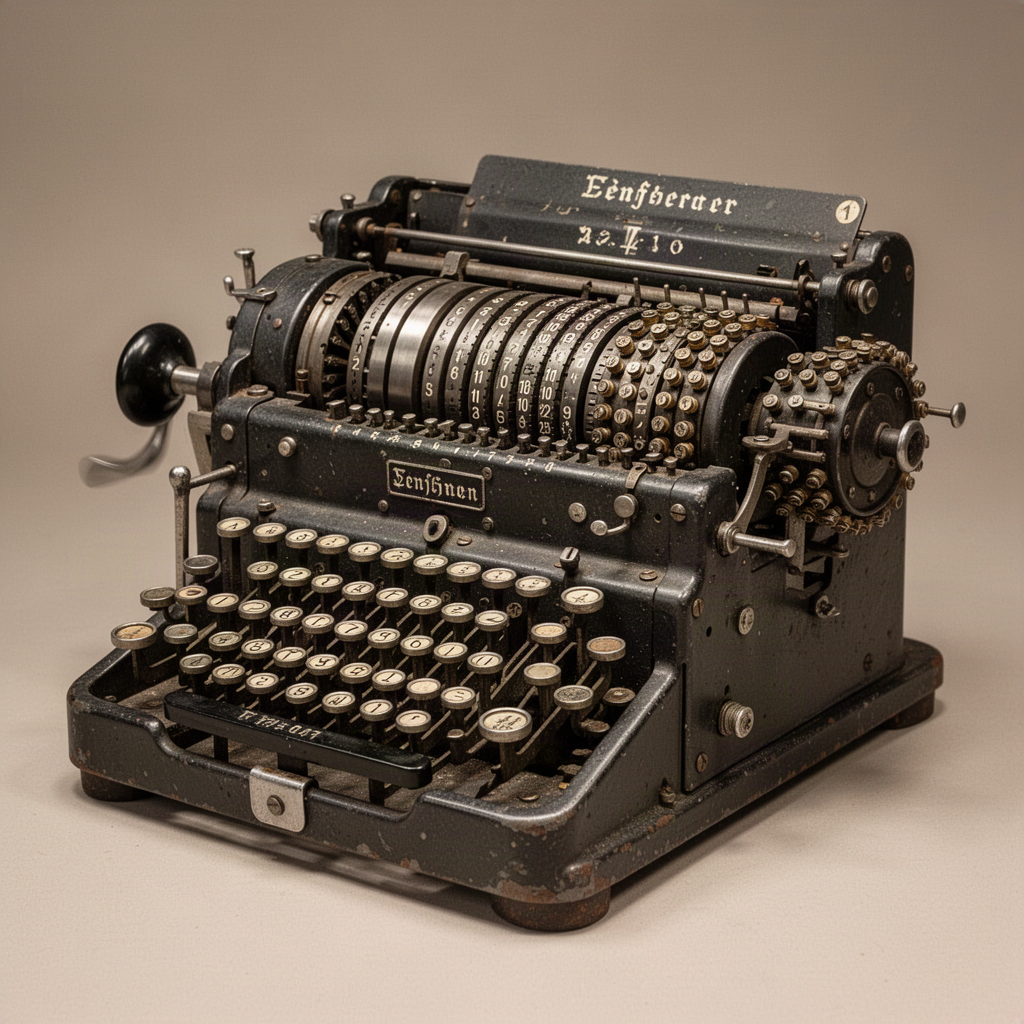 The Enigma machine was invented by German engineer Arthur Scherbius in 1918 and was used extensively by Nazi Germany during World War II to encrypt military communications. Its complex system of rotors and plugboards made it seemingly unbreakable, until Allied codebreakers at Bletchley Park, led by mathematician Alan Turing, cracked its code — a breakthrough widely credited with shortening the war. For the longest time I thought the Enigma is where cryptograms originated. An historical biographical drama called The Imitation Game (2014) is about Alan Turing and his team breaking the Enigma code. Oscar winning movie and worthwhile to see. Highly recommended!
Explore the Archives
Select a date to explore its history
| Su | Mo | Tu | We | Th | Fr | Sa |
|---|---|---|---|---|---|---|